East Valley Homeowner Guide
Is My Tree a Hazard? Signs to Watch
Published September 18, 2026 · Last reviewed · Gilbert, Chandler, Mesa, Queen Creek & San Tan Valley, AZ (East Valley)
The short answer
As of September 2026, the clearest hazard signs on an East Valley tree are a new or worsening lean, roots visibly heaving the soil or hardscape near the base, large dead or hanging limbs in the canopy, cracks or splits in the trunk or major branch unions, and fungal growth or mushrooms at the base — any one of these is worth a professional assessment before monsoon winds test the tree's structural integrity.
East Valley Tree Care · (480) 555-0140 · matching East Valley homeowners with independent, insured tree service companies.
Most homeowners don’t call about a tree until something looks obviously wrong — but the trees most likely to cause real damage often look fine from a distance. Here are the six signs actually worth walking your yard to check for, and what each one means.
A leaning trunk that’s new or getting worse
A tree that has always leaned a certain way, gently, toward light or away from a prevailing wind, isn’t automatically a problem. What matters is change: a lean that’s new, that’s gotten more pronounced recently, or that’s paired with heaved or cracked soil on the opposite side of the lean (a sign the roots on that side are pulling loose rather than holding). If you have an old photo of your yard, it’s a genuinely useful way to check whether a lean has actually changed.
Root heave and soil cracking near the base
Root heave — roots visibly lifting and cracking a sidewalk, patio slab, or the soil surface close to the trunk — is common across the East Valley because much of the area sits on heavy clay or caliche soil that keeps roots shallower than they’d otherwise grow. Mesquite is a common local species where this shows up. It’s not just a hardscape nuisance: heaved roots near the base mean the tree’s actual underground anchoring is thinner than a full, healthy-looking canopy might suggest.
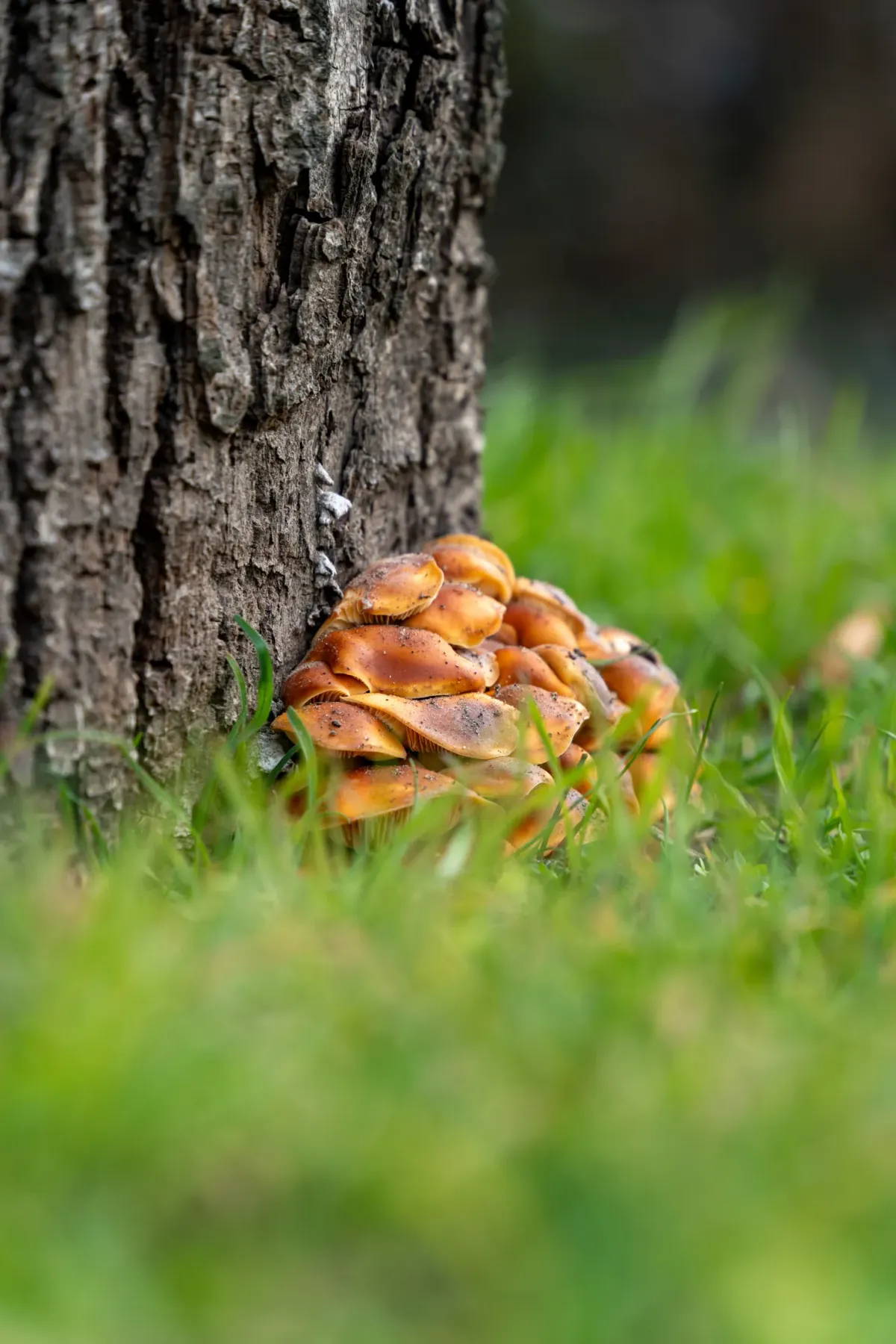
Fungal growth or mushrooms at the trunk base
Mushrooms or shelf-like fungal growth at the base of a trunk or at a major root flare is one of the more reliable physical signs of internal decay, since many of the fungi that produce visible growth are actively breaking down wood fiber inside the tree or its root system. This can be present well before a tree shows any visible canopy stress, which is part of why it’s worth checking the base directly rather than only looking up.
Large dead or hanging limbs
A dead limb still attached to an otherwise living tree — sometimes called a “widowmaker” — can fail with no warning at all, since dead wood doesn’t bend or telegraph stress the way live wood often does. Limbs that are already partially broken or hanging are an even more immediate concern, particularly over a driveway, walkway, patio, or anywhere people or vehicles regularly pass underneath.
Cracks, splits, or included bark at branch unions
A visible crack or split in the trunk, or in a major branch union, is a structural red flag regardless of how the rest of the tree looks. “Included bark” — where two branches or trunks grow so close together that bark gets pinched between them instead of forming a normal, strong union — is a related, less obvious pattern that tends to fail at that union under wind load.
Canopy dieback concentrated on one side
Thinning, browning, or bare branches concentrated on one side of an otherwise full canopy can point to root damage or soil compaction on that side, construction or trenching activity near the roots, or a spreading internal problem. Dieback spread evenly across the whole canopy is more often a watering, seasonal, or general-health issue — the lopsided pattern is the more specific hazard signal.
What to do if you spot one of these
None of these signs are a DIY diagnosis-and-fix situation — an arborist or tree service pro can look at the tree’s specific size, species, lean angle, and location relative to your house, driveway, and property line, and give you an actual read on urgency, not just a general warning. If you’ve spotted one of these signs, get a professional assessment rather than waiting to see whether it gets worse, especially heading into monsoon season when wind load tests exactly the kind of structural weakness these signs point to.
FAQ
Is My Tree a Hazard? Signs to Watch: Questions East Valley Homeowners Ask
What's the difference between a hazard tree and one that just needs trimming?
A tree that needs trimming is otherwise structurally sound — the work is about shape, clearance, or reducing weight, not about the tree's ability to stand. A hazard tree shows a sign that its structural integrity is actually compromised: a new lean, root heave, a major crack, large dead limbs, or fungal growth at the base. Overgrown and unhealthy-looking aren't automatically the same as hazardous — a tree can look a little rough and still be structurally fine, and a tree can look green and full right up until it fails if the problem is underground or inside the trunk.
Why do East Valley trees seem to fail with little warning?
Two locally common patterns explain most of it. Sissoo trees, a popular fast-growing East Valley shade tree, have a local reputation for aggressive shallow roots and sudden limb failure or whole-tree tip-over in strong wind, sometimes with a canopy that still looks fully healthy. And much of the East Valley sits on heavy clay or caliche soil that keeps roots relatively shallow, so a tree's actual underground anchoring can be weaker than a healthy-looking canopy suggests. See our [sissoo and mesquite guide](/guides/sissoo-mesquite-tree-problems-arizona/) for more detail on both.
Is a leaning tree always dangerous?
Not always — some trees have grown with a natural, long-standing lean toward light and are perfectly stable. What matters is whether the lean is new, worsening, or paired with other signs like heaved soil on the side opposite the lean (a sign roots are pulling loose) or cracking at the base. If you're not sure whether a lean is new, compare it to an old photo of your yard if you have one, or have it assessed — that's exactly the kind of judgment call worth a professional look rather than a guess.
What should I do if I spot a hazard sign?
Keep people, vehicles, and pets away from the area underneath and immediately downwind of the tree, and arrange for a professional assessment rather than waiting to see what happens or attempting to address it yourself. If the tree is actively failing, over a structure, or came down partially in a storm, treat it as an emergency — see our [storm and emergency page](/storm-emergency-tree-removal-east-valley-az/) for same-day response options.
Do I need to remove a hazard tree, or can it sometimes be saved?
It depends on what's actually wrong and how far along it is — a tree with one dead major limb might just need that limb removed and monitoring going forward, while a tree with significant root heave, a major trunk crack, or advanced base decay is a more likely removal candidate. This is a genuine case-by-case call that needs an in-person look rather than a photo or a description alone. See our [leaning and hazard tree removal page](/hazard-leaning-tree-removal/) for what that evaluation and, if needed, removal typically involves.
Keep reading
Related East Valley tree service pages
Ready to get matched with a local East Valley tree pro?
Tell us what your tree is doing and we'll connect you with an independent, insured pro serving Gilbert, Chandler, Mesa, Queen Creek, or San Tan Valley. No obligation to hire.